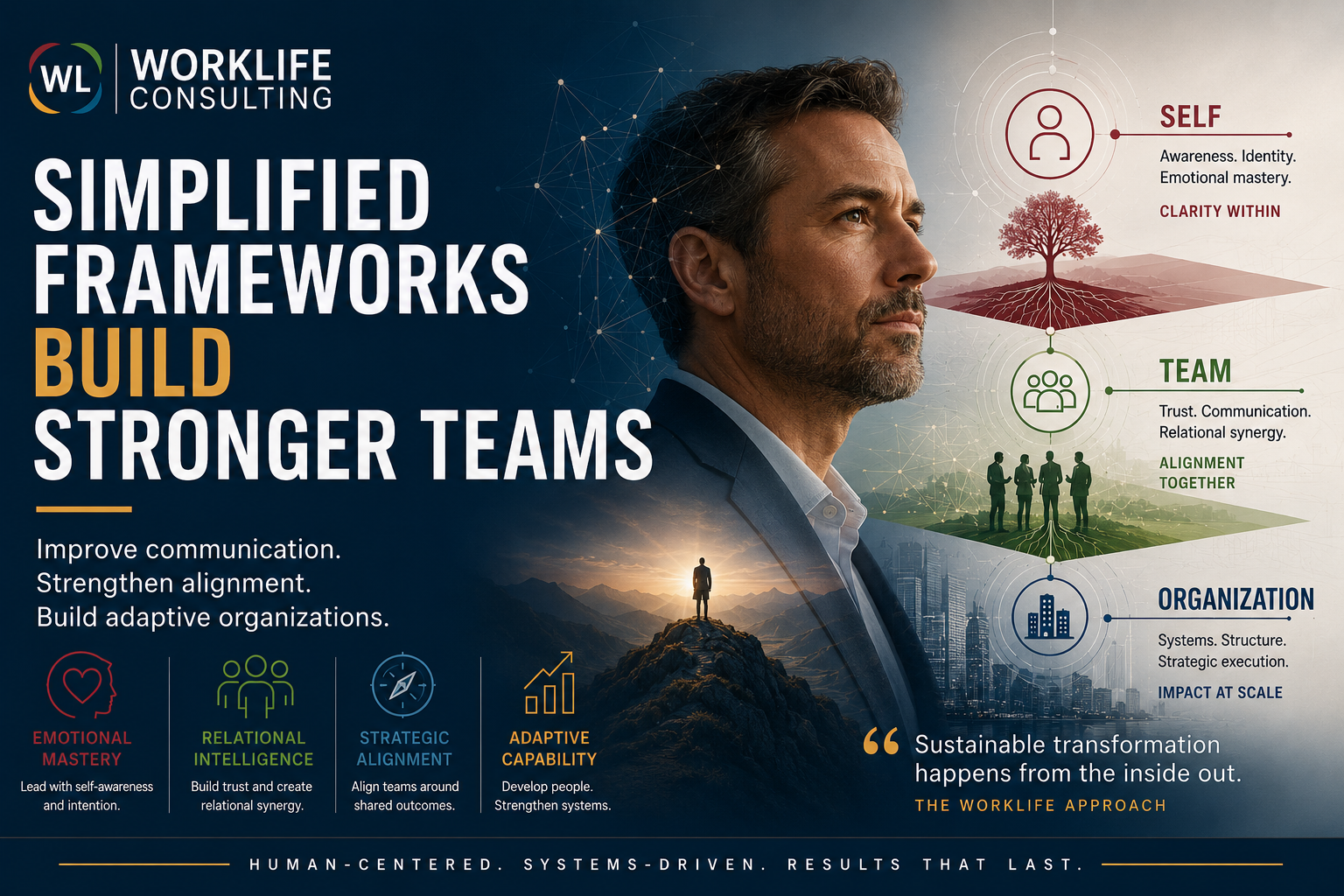
Simplified Frameworks Build Stronger Teams
Why visual leadership education matters more than ever
Most organizations don’t struggle because people lack talent.
They struggle because communication becomes complicated, fragmented, and disconnected from how humans actually work together.
That’s why simplified frameworks matter.
When leaders can clearly explain:
how teams communicate,
how trust is built,
where alignment breaks down,
and what healthy collaboration looks like,
teams move faster with less friction.
WorkLife Consulting’s methodology is built around a simple but powerful principle:
“Organizations are collections of selves. Sustainable transformation happens from the inside out.”
This idea challenges the traditional “top-down” approach to organizational change.
Most companies try to improve performance by changing systems first:
Organization → Team → Individual
But WorkLife’s framework reverses the sequence:
Self → Team → Organization
Why?
Because communication problems inside teams are rarely just communication problems.
They are often:
trust problems,
clarity problems,
emotional intelligence problems,
identity problems,
or leadership adaptability problems.
The visible issue is usually only the surface layer.
As described in the Organizational Archaeology framework, organizations often focus on “surface artifacts” like org charts, KPIs, reporting structures, and processes, while the deeper drivers live underneath: fear, trust, motivation, relational maturity, and inherited assumptions.
That’s why educational content and visual frameworks matter so much today.
People don’t need more complicated leadership language.
They need:
clearer thinking,
more usable models,
and frameworks they can actually apply in real conversations.
A strong visual framework can help teams:
communicate more clearly,
identify friction faster,
align around shared outcomes,
and understand how human behavior impacts organizational performance.
According to the WorkLife methodology, teams become more effective not through forced sameness, but through “relational synergy through differentiated contribution.”
In other words:
Healthy teams are not built by making everyone think alike.
They are built by helping people understand how to work together more intentionally.
This is especially important for:
executives navigating organizational change,
department leaders managing communication breakdowns,
high-achieving professionals leading under pressure,
women in leadership roles,
and organizations trying to create healthier cultures without losing performance.
The goal is not just better communication.
The goal is adaptive capability.
As the WorkLife Human Systems Model explains, sustainable organizational growth is the outward expression of aligned human capability.
That’s why simplified educational frameworks work so well in modern leadership content:
They make invisible organizational dynamics visible.
And once people can see the system more clearly, they can finally begin to change it.
Key Takeaways
1. Most communication problems are human-system problems
Teams often focus on symptoms instead of underlying relational dynamics.
2. Simplicity creates clarity
The best leadership frameworks are understandable, practical, and repeatable.
3. Teams improve when trust improves
Strong communication is built on emotional intelligence, self-awareness, and relational maturity.
4. Visual education increases engagement
Educational carousels and simplified frameworks help people retain and share insights more effectively.
5. Sustainable growth starts inside-out
Healthy organizations are built by developing people first.
What communication challenge do you see affecting teams most often today?
Share your thoughts in the comments or connect with WorkLife Consulting to continue the conversation.