
Why Caution Is Not Always Resistance—and Speed Is Not Always Commitment

building-commitment-to-decisions-worklife-consulting
Learn how leaders can distinguish resistance from responsible caution, uncover what people need to commit, and make decisions that produce stronger execution.
“Why are we still discussing this? Is the team committed or not?”
It is a question leaders often ask when a decision feels complete but movement remains uneven.
The meeting has ended. The direction has been announced. Responsibilities may even have been assigned. Yet someone continues asking questions. Another person wants more time. A third agrees in the room but does not follow through afterward.
From the leader’s perspective, these behaviors can look like resistance.
Sometimes they are.
But sometimes they reveal something more important: the conditions people need for responsible commitment have not yet been met.
One person may need more context. Another may need clearer ownership. Someone closer to the work may see an implementation risk that has not been discussed. A team member may understand the decision but remain uncertain about the authority, resources, or tradeoffs involved.
When leaders interpret every hesitation as opposition, they may create surface agreement without building the clarity required for execution.
A fast decision is not necessarily a complete decision. Visible agreement is not necessarily commitment.

This is why some decisions appear settled but return repeatedly.
The team may not have made a poor choice. It may have failed to establish the conditions that turn a choice into coordinated action.
Commitment does not require everyone to prefer the decision. It does require enough clarity for people to act responsibly within it.
A team member may disagree with the final direction and still commit to carrying it out. Conversely, someone may enthusiastically agree with a proposal while lacking the information, capacity, or ownership needed to execute it.
Leaders therefore need to ask more than, “Are we all on board?”
They need to ask, “What does each person need to move from understanding to responsible action?”
What Leaders Can Misread as Resistance
Under pressure, leaders naturally look for momentum. Questions, pauses, and requests for further discussion can feel like obstacles.
The visible behavior, however, does not always reveal the underlying concern.
A request for more data may be an attempt to understand the consequences of a decision.
A question about staffing may reflect knowledge of an operational constraint.
A desire to involve another department may come from recognizing an important dependency.
A request to clarify decision rights may reflect uncertainty about who can authorize changes once implementation begins.
Even silence can have multiple meanings. It may signal agreement, confusion, resignation, caution, or a belief that raising concerns is no longer welcome.
When leaders treat these behaviors as proof that someone is “not on board,” they narrow the conversation too quickly. People may stop contributing without becoming more committed.
That silence can create the appearance of alignment while unresolved concerns move underground.
The Human System Beneath a Decision
Decisions do not move through organizations as simple instructions. They move through a human system.
People interpret a decision through their roles, experiences, responsibilities, relationships, incentives, and exposure to risk.
The executive sponsoring a change may see strategic urgency.
The operational leader may see staffing demands and process disruption.
The finance partner may see cost and resource constraints.
The frontline manager may anticipate employee and customer questions.
The subject-matter expert may notice technical dependencies that are invisible at the executive level.
These are not automatically competing loyalties. They are different positions within the same system.
Each person is carrying information that comes from where they sit. When those perspectives are not surfaced, the organization loses access to part of its own intelligence.
The leadership challenge is not to let every concern delay every decision. It is to distinguish between unproductive obstruction and information that could improve commitment or execution.
Four Conditions That Support Commitment
Before concluding that hesitation is resistance, leaders can examine four practical conditions.
1. Understanding
Does the person understand the decision, its purpose, and the reasoning behind it?
Knowing what was decided is not the same as understanding why it matters. Without context, people may comply mechanically, make inconsistent choices, or struggle to explain the direction to others.
Ask:
What remains unclear about the decision?
What context would help you apply it?
What do you believe we decided?
That final question can be especially revealing. People often leave the same meeting carrying different interpretations.
2. Contribution
Did the person have an appropriate opportunity to contribute relevant knowledge?
Not everyone needs an equal vote in every decision. But people are more likely to support a decision when the process makes legitimate use of what they know.
Leaders should clarify:
Who provides input?
Who recommends a direction?
Who makes the final decision?
Who must be consulted before execution?
Who needs to be informed afterward?
When these roles remain ambiguous, people may continue advocating because they do not know whether their perspective was considered or simply heard.
3. Feasibility
Does the person believe the decision can be executed with the available time, authority, resources, and capacity?
A leader may hear, “This will be difficult,” as unwillingness.
The employee may mean, “The current plan depends on conditions that do not exist.”
Responsible commitment sometimes requires naming the gap between aspiration and operating reality. If people learn that feasibility concerns will be labeled negativity, they may stop surfacing those concerns. The problems then appear later during execution.
Ask:
What could prevent this from working?
Which dependency concerns you most?
What resource or authority is still missing?
What would make this plan executable?
These questions help separate discomfort with change from a concrete implementation risk.
4. Ownership
Does the person know what they own and what authority accompanies that responsibility?
“Let’s move forward” is not an ownership structure.
Teams need clarity about the outcome, decision rights, responsibilities, deadlines, escalation paths, and check-back points.
Without those elements, work can stall while everyone assumes someone else is acting. Leaders may then interpret the delay as a motivation problem when the underlying issue is structural ambiguity.
Ask:
Who owns the next action?
What can that person decide independently?
Where is consultation required?
When will the work be completed?
When will we review progress?
Ownership becomes credible when authority and accountability are aligned.
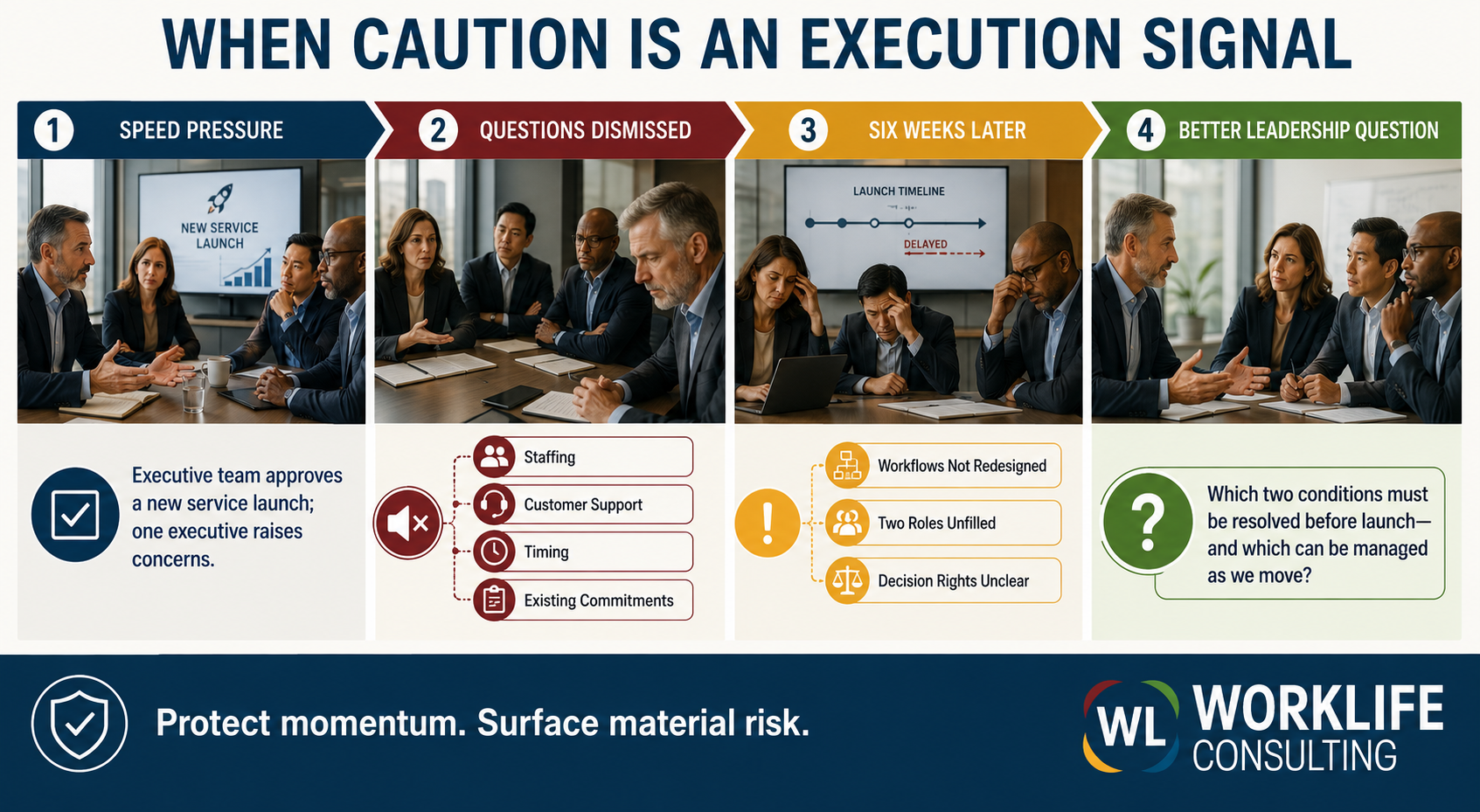
Speed and Caution Are Both Forms of Intelligence
Decision styles are sometimes treated as personality differences, but they also serve organizational functions.
Speed can create momentum, prevent overanalysis, and help an organization respond to opportunity.
Caution can expose risk, improve coordination, and prevent avoidable rework.
Either tendency becomes costly when it operates without challenge.
Speed without clarity may produce a quick announcement followed by slow execution. Caution without decision discipline may produce repeated analysis without movement.
The leadership task is not to decide which style is better. It is to use both forms of intelligence in service of the decision.
A fast-moving leader can ask:
“What is the minimum information we need to move responsibly?”
A cautious team member can ask:
“Which concern would materially change the decision, and which can be managed during implementation?”
These questions turn differences in pace into useful contributions.
How to Test for Commitment
Leaders often test commitment by asking:
“Is everyone aligned?”
“Can we all support this?”
“Are there any objections?”
These questions invite a yes-or-no response. They may also imply that additional concerns are unwelcome.
Instead, test the conditions beneath commitment:
What do you understand the decision to be?
What concern still needs to be surfaced?
What do you need to execute responsibly?
What are you willing to own?
What authority or support will that require?
What should trigger a review of this decision?
These questions do not promise consensus. They produce information.
They also allow a leader to establish a boundary when further discussion will not improve the decision:
“We have considered the major risks, and the decision is now final. Before we move into execution, I want to confirm the ownership and support.”
This communicates that inquiry has a purpose and a limit.
A Five-Minute Commitment Check
Before closing your next complex decision, ask each person to state:
The decision as they understand it
The outcome the team is trying to produce
The responsibility they own
The authority or support they need
One condition that could affect follow-through
Listen for differences.
If people describe different decisions, the team needs clarity.
If ownership is vague, the team needs structure.
If a concern reveals a material risk, the team needs a response.
If the same objection continues after the relevant conditions have been reasonably addressed, the issue may be genuine resistance. The leader can then address it directly and fairly.
The purpose is not to keep every decision open. It is to close the right decision with enough clarity to support action.
Commitment Is Designed, Not Announced
Leaders cannot create commitment simply by declaring that a conversation is over.
They can create the conditions that make responsible commitment possible.
That means explaining enough context, using relevant perspectives, confronting feasibility honestly, and making ownership explicit. It also means recognizing that people may arrive at commitment through different paths.
Some people need the destination first.
Some need to understand the reasoning.
Some need to test the risks.
Some need to know how their work will change.
Some need an opportunity to contribute before they can support what follows.
These differences do not have to slow the organization. When surfaced and managed well, they can help it move with greater precision.
Before labeling someone resistant, ask:
What condition for commitment has not yet been surfaced?
The person may not be refusing to move.
They may be trying to understand how to move responsibly.
Frequently Asked Questions
-
No. Commitment does not require unanimous preference. Leaders should clarify who makes the decision, how input will be used, and what responsible support looks like afterward.
-
Ask the person to make the concern specific. Caution usually points toward information, risk, feasibility, involvement, or ownership. Resistance may remain general or continue after the relevant conditions have been reasonably addressed.
-
They can if the conversation has no boundaries. Focus on concerns that could materially affect the outcome. A brief commitment check can prevent much longer implementation delays.
-
Acknowledge the disagreement, clarify that the decision is final, and define the implementation expectations. Then ask what the person needs to execute responsibly.
-
Ask: “What information, involvement, support, or ownership is still missing for responsible commitment?”
Before closing your next complex decision, ask each person: “What condition for commitment has not yet been surfaced?”