
How Can Teams Turn Disagreement Into Better Decisions?
Most teams do not struggle simply because people disagree.
They struggle because the disagreement has no clear structure.
A leadership team begins discussing an important decision. One person wants to move quickly. Another wants more information. Someone raises concerns about risk. Another believes the team has already spent too much time discussing the issue.
The conversation becomes tense.
What began as a difference in perspective may quickly become a judgment about the people involved:
They are resisting.
They are controlling.
They are overthinking.
They are not committed.
They are making the process harder than necessary.
At that point, the team is no longer working only on the decision.
It is also managing frustration, assumptions, defensiveness, and competing interpretations of what the disagreement means.
The issue may not be that the team has too much difference.
The issue may be that it has not created enough structure to use the difference well.
Disagreement Is Not Necessarily the Problem
Many leaders say they want open discussion.
They want team members to raise concerns, challenge assumptions, and offer different perspectives.
But when disagreement slows the conversation or creates discomfort, the team may begin treating difference as an obstacle.
This creates a difficult contradiction.
People are invited to speak honestly, but only when their perspective does not interfere with the preferred pace, direction, or decision.
Over time, team members learn which contributions are welcomed and which ones create friction.
Some begin withholding concerns.
Others raise objections more forcefully because they do not believe a quieter approach will be heard.
Still others disengage and allow the decision to move forward without their full commitment.
Psychological safety is not created by eliminating tension.
It is strengthened when the team has reliable ways to work through tension without reducing people to labels.
When Difference Becomes Personal
A difficult team conversation may begin with competing priorities.
One leader may be protecting speed.
Another may be protecting quality.
Someone else may be protecting employee readiness, financial stability, the client relationship, or the organization’s reputation.
Each concern may be legitimate.
The conversation becomes less productive when team members stop examining the concerns and begin assigning motives to one another.
A request for more information becomes resistance.
A desire to move quickly becomes control.
A concern about risk becomes negativity.
A need for reflection becomes disengagement.
Once the disagreement becomes personal, the team may spend more energy defending identities and intentions than clarifying the work.
Productive Disagreement Requires Structure
Difference does not become useful simply because people have good intentions.
Teams need a structure that helps them identify what the disagreement is contributing and what must become clear.
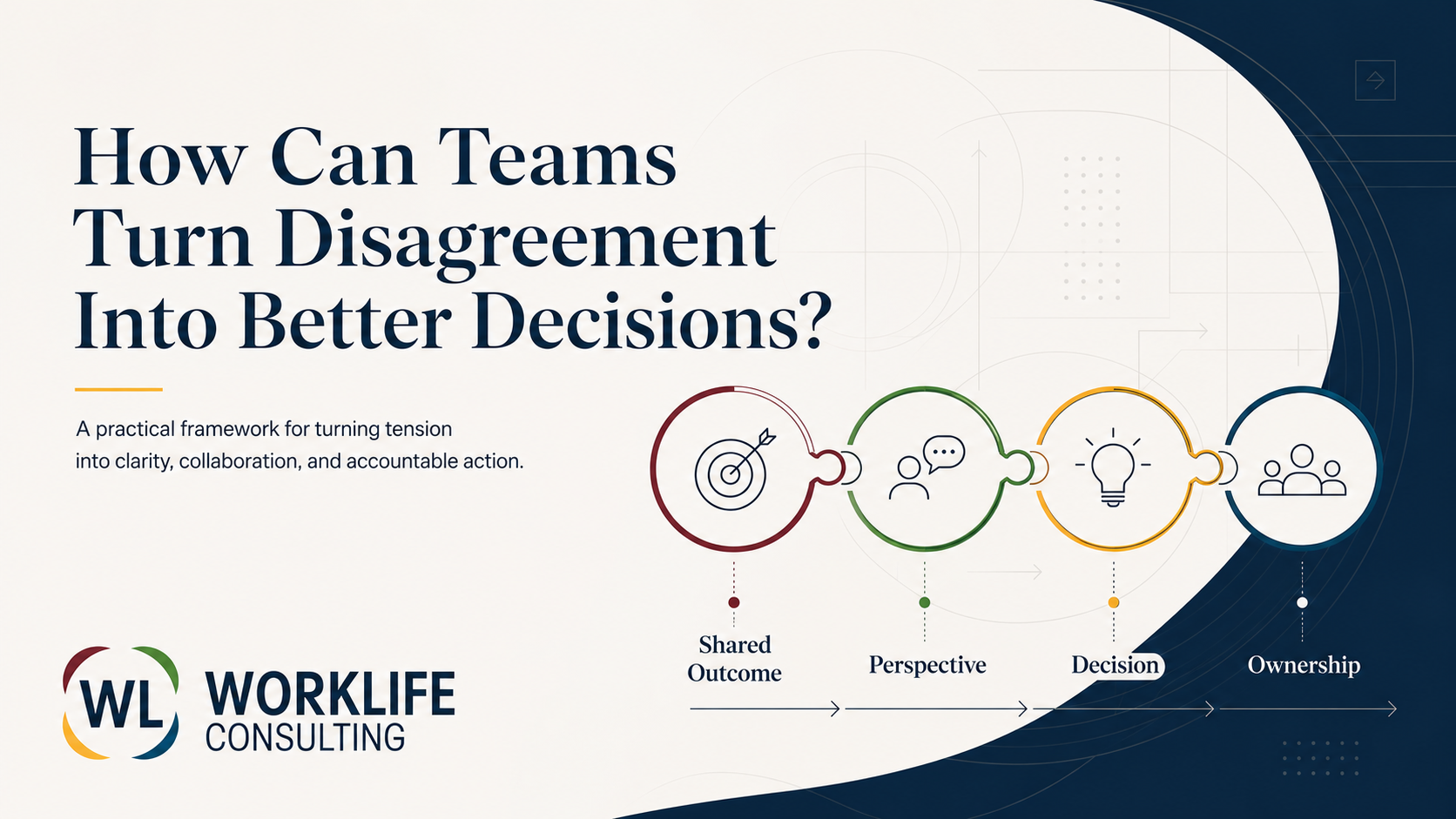
A practical reset is to return the conversation to four elements:
Shared outcome
Perspective
Decision
Ownership
These elements help the team separate the people from the problem and clarify what the conversation needs to accomplish.
The Four-Part Collaboration Reset
1. Clarify the Shared Outcome
Before debating how to proceed, confirm what the team is trying to accomplish together.
Teams often assume they agree on the outcome when they are actually protecting different results.
One person may be protecting speed.
Another may be protecting quality.
Another may be protecting employee readiness.
Someone else may be protecting trust, continuity, or long-term execution.
Ask:
What outcome are we collectively responsible for creating or protecting?
This question helps the team distinguish the shared objective from each person’s preferred approach.
It also gives the disagreement somewhere productive to return.
2. Surface the Perspectives
Different people notice different parts of the system.
One leader may see urgency.
Another may see operational risk.
Someone closer to employees may see confusion that executives cannot yet observe.
A person asking for more detail may not be resisting the decision. They may be identifying information the team needs before implementation.
Useful questions include:
What are you seeing that others may be missing?
What concern feels most important to address?
What outcome or need are you trying to protect?
What information would help you move forward?
What would make this decision more responsible or workable?
The purpose is not to debate every perspective indefinitely.
It is to make sure relevant information enters the conversation before the decision is finalized.
3. Define the Decision
Teams sometimes leave meetings believing a decision has been made when different people have different understandings of what was decided.
One person believes the team approved the full plan.
Another believes it approved only the next phase.
Someone else believes the conversation was exploratory.
The meeting ends, but the interpretation continues.
Ask:
What decision are we making today?
Then state it clearly.
The decision should distinguish:
What has been approved
What remains open
What criteria shaped the decision
What information could cause the team to revisit it
What is not being decided today
Clarity does not require perfect certainty.
It requires enough shared understanding for people to act responsibly.
4. Make Ownership Explicit
A decision without ownership often becomes another conversation.
The team may agree in principle but remain unclear about:
Who is responsible
What authority that person has
What support is required
When the next step is due
When the team will review progress
Ask:
Who owns the next action, by when, and with what authority?
Ownership should not be implied by job title, seniority, or who spoke most during the meeting.
It should be confirmed.
A Workplace Example
Imagine a leadership team discussing the launch of a new internal initiative.
The executive sponsor wants to move quickly because the initiative supports an important strategic goal.
The operations leader asks for more time to assess capacity.
The communications leader believes employees need more context before the launch.
The project lead becomes frustrated and says the team is losing momentum.
The discussion begins to feel like a conflict between people who support the initiative and people who do not.
The Four-Part Collaboration Reset changes the conversation.
Shared outcome
The team agrees that the goal is not simply to launch quickly.
The goal is to launch in a way that employees understand and managers can support.
Perspective
Operations identifies a capacity risk.
Communications identifies a meaning and clarity risk.
The executive sponsor explains the strategic timing.
Decision
The team decides to proceed but adjusts the launch sequence.
Ownership
The project lead owns the revised implementation plan.
Communications owns the manager briefing.
Operations identifies the capacity checkpoints.
The differences remain.
But they are no longer treated as evidence that someone is difficult or uncommitted.
Each perspective becomes part of a stronger decision.
The Self, Team, and Organization Connection
Self: Notice What You Protect
Leaders carry preferences, assumptions, and stress responses into disagreement.
One leader may protect speed.
Another may protect certainty.
Someone else may protect harmony, control, credibility, or inclusion.
These preferences shape how leaders interpret other people’s behavior.
A leader who values speed may interpret reflection as delay.
A leader who values harmony may interpret direct disagreement as unnecessary conflict.
A leader who values precision may interpret an incomplete proposal as irresponsibility.
Self-awareness helps leaders notice the lens through which they are reading the interaction.
Team: Create Reliable Ways to Disagree
Teams need norms that make it possible to disagree without attacking motives.
This may include:
Asking clarifying questions before responding
Separating observable behavior from assigned meaning
Naming the shared outcome
Inviting perspectives that have not yet been heard
Restating the decision before leaving the meeting
Confirming ownership and follow-through
When these practices become consistent, team members do not have to choose between silence and escalation.
Organization: Turn Difference Into Capability
When teams use difference well, the organization gains access to:
More complete information
Stronger decisions
Clearer ownership
Earlier identification of risk
Greater commitment
More reliable execution
When difference is suppressed or personalized, concerns remain hidden and commitment becomes fragile.
The organization may appear aligned while people carry different interpretations of what was decided.
A Practice for Your Next Difficult Conversation
When a discussion begins repeating itself or becoming personal, pause and say:
“Before we continue, can we clarify four things?”
What outcome are we trying to protect?
What is each perspective helping us see?
What decision are we making?
Who owns the next action?
The pause may feel slower in the moment.
But clarity can prevent the team from revisiting the same decision later.
Difference becomes team capability when it is understood, structured, and used.
Frequently Asked Questions
How can teams disagree productively?
Teams can disagree more productively by clarifying the shared outcome, inviting relevant perspectives, defining the decision, and assigning ownership. This structure helps prevent disagreement from becoming a judgment about people’s motives or commitment.
What causes team conflict?
Team conflict can come from different goals, assumptions, needs, communication styles, decision preferences, unclear roles, or missing information. The visible disagreement may be only one part of the larger human system shaping the interaction.
Does psychological safety mean avoiding conflict?
No. Psychological safety does not mean avoiding disagreement or difficult feedback. It means people can raise questions, concerns, and different perspectives without being punished, dismissed, or reduced to a negative label.
How can leaders prevent disagreement from becoming personal?
Leaders can separate observable behavior from assigned motive, ask what each perspective is contributing, return the team to the shared outcome, and clarify the decision and ownership.
What should a leader say when a team discussion becomes tense?
A leader can say:
“Before we continue, can we clarify the outcome, the perspectives, the decision, and the ownership?”
This helps slow interpretation and return the group to the work.
Final Thought
High-performing teams do not need everyone to see the situation in the same way.
They need a reliable way to use what different people see.
Disagreement becomes destructive when assumptions replace inquiry and tension becomes personal.
It becomes useful when leaders create enough structure to clarify the outcome, understand the perspectives, complete the decision, and establish ownership.
Difference does not have to disappear.
It needs enough structure to become capability.
Work With Us
WorkLife Consulting helps leaders and teams understand the human systems beneath communication, conflict, decisions, and organizational performance.
Our leadership development, team workshops, and organizational consulting engagements help teams strengthen collaboration, improve decision clarity, and turn different perspectives into practical capability.
Ready to strengthen how your leadership team navigates disagreement?
Email laurabutler@worklifeonline.com to discuss a customized leadership or team-development engagement.
Ready to Turn Team Tension Into Stronger Collaboration?
WorkLife Consulting offers customized leadership development, team workshops, and facilitated conversations designed to help organizations improve trust, decision clarity, accountability, and collaboration.
Email laurabutler@worklifeonline.com to begin a conversation.